
Commercial Fencing Solutions for Mesquite Businesses and Property Managers
Chain link, ornamental iron, and security perimeter fencing for commercial properties, facilities, and institutions across Mesquite and East Dallas, with free estimates on every project.
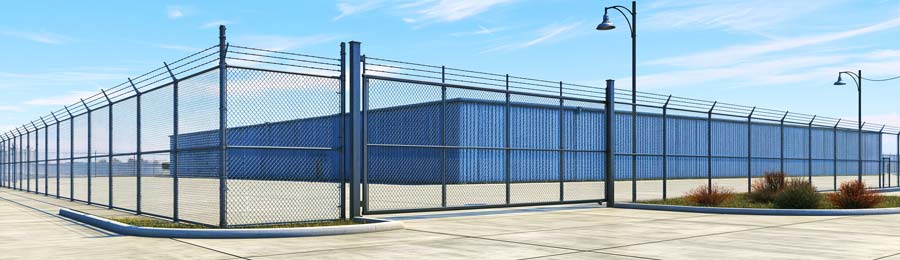
Commercial Fencing Applications Across the Mesquite Area
Commercial fencing serves a different set of requirements than residential work. The materials are heavier, the spans are longer, the access control needs are more complex, and the installation timeline often has to work around business operations rather than a homeowner’s schedule. The application determines the specification — and the right material for a construction site perimeter is rarely the right material for a business frontage.
Chain Link for Security Perimeters and Industrial Properties
Chain link is the dominant commercial fencing material in the Mesquite market and across East Dallas. It’s the standard specification for:
- Construction site enclosures and temporary security perimeters
- Equipment yards, fleet storage areas, and utility facility perimeters
- Industrial property boundaries and loading dock enclosures
- Parking lot perimeters and institutional facility fencing
- Any application where security, durability, and cost-effectiveness are the primary criteria
Commercial chain link installations use heavier gauge fabric, larger post diameters, and tighter post spacing than residential work. 9-gauge fabric with 2-3/8 inch line posts and 2-7/8 inch terminal posts is the standard commercial specification. Barbed wire and razor wire topping options are available for security-critical applications where deterrence above the fence line is part of the requirement.
Ornamental Iron and Aluminum for Business Frontages
For commercial properties where appearance matters alongside security — office parks, retail centers, medical facilities, and institutional campuses — ornamental iron and aluminum fencing is the appropriate specification at street-facing perimeters. Powder-coated ornamental fencing communicates permanence and professionalism in a way chain link doesn’t, while still providing clear property boundary definition and controlled access points. Gate integration for vehicle and pedestrian access is typically part of the scope from the outset on these projects.
How Commercial Specifications Differ From Residential
The practical differences between commercial and residential fence installations:
- Post depth and footing: commercial posts are set deeper in larger-diameter concrete footings to handle longer spans and higher structural loads
- Hardware: commercial-grade hinges, latches, and tension hardware rated for higher use frequency and heavier gate weights than residential hardware
- Span length: commercial fence runs often cover significantly more linear footage, requiring accurate site measurement and material staging before installation begins
- Project coordination: commercial installations are frequently phased to minimize disruption to business operations, which requires scheduling coordination with the property manager or facilities contact before work begins
Security Perimeters, Access Control and Commercial Gate Systems
Gate Integration, Access Control and Project Logistics
Gate Systems for Commercial Properties
Commercial fencing projects almost always include vehicle access gates, and often pedestrian gates at multiple perimeter points. Vehicle gate openings for commercial properties typically range from 14 to 24 feet for standard delivery and service truck access. Slide gates are more common than swing gates at commercial entries — they require no clearance behind the gate opening and hold up better under the high-frequency use commercial access points see daily. Automatic operators for commercial applications are specified for significantly higher cycle counts than residential operators.
Automatic driveway gates and custom gate fabrication cover the full range of gate configurations available for commercial applications, including access control integrations.
Access Control Integration
Commercial gate systems can be integrated with keypad, intercom, card reader, or remote receiver access control depending on the security requirements of the property. We design the gate installation to accommodate the access control system the property requires rather than specifying access control independently — coordination with the property’s security contractor or IT infrastructure is part of the commercial project process when access control is in scope.
Installation While the Business Remains Operational
Most commercial fence installations can be phased to keep access routes open and business operations running during the installation period. The phasing plan is established during the estimate conversation based on the property layout, access point locations, and the business’s operational schedule. Projects that can’t tolerate access disruption during business hours can often be scheduled for after-hours or weekend installation for specific phases where that’s the constraint.
Permits and Project Coordination
Commercial fence installations in Mesquite require permits in most cases. The permitting process for commercial work is more involved than for residential projects and varies by fence height, proximity to property lines and public right-of-way, and local zoning designation. Permit requirements and lead times are reviewed as part of every commercial estimate so the permitting sequence is factored into the project schedule before installation begins.
Chain link fence installation and ornamental iron fence installation provide additional material-specific detail for property managers evaluating options across both commercial and residential managed properties.
Every commercial fence estimate is free, based on a site visit, and covers material specifications and access control options before any scope is confirmed.
Common Questions About Commercial Fencing in Mesquite
What types of fencing work best for commercial properties?
The right material depends on the application. Chain link is the most widely used commercial fencing material — it’s durable, cost-effective, and appropriate for security perimeters, industrial properties, construction sites, and any application where function and longevity outweigh aesthetics. Ornamental iron and aluminum are the standard choices for business frontages, institutional campuses, and any commercial property where the fence is a visible part of the property’s presentation. Vinyl and wood fencing are occasionally used in commercial applications for lower-security enclosures or where a specific aesthetic is required, but they’re not the typical specification for perimeter security work.
How does commercial fencing differ from residential fencing?
Commercial installations involve heavier material specifications, longer fence runs, and more complex access control requirements than residential work. Commercial chain link uses heavier gauge fabric, larger post diameters, and deeper concrete footings than residential chain link of similar height. Gate hardware is rated for higher use frequency. The project coordination process is more involved — commercial installations often need to be phased around business operations, require commercial permits rather than residential permits, and frequently include access control integrations that residential projects don’t. The estimate process for commercial work is more detailed for these reasons, and an on-site visit is even more important than in residential work before any scope or pricing is confirmed.
Do commercial fencing projects in Mesquite require permits?
Yes, in most cases. Commercial fence installations are subject to permitting requirements that vary by fence type, height, proximity to property lines and public right-of-way, and the zoning designation of the property. The commercial permitting process is typically more involved than residential fence permitting and involves longer review timelines in some cases. Electrical permits are also required when automatic gate operators involve new wired connections. Permit requirements and anticipated lead times are reviewed as part of every commercial estimate so the permitting sequence can be planned into the project schedule before work begins.
How long does commercial fence installation take?
Timeline varies significantly by project scope. A standard perimeter fence installation at a single commercial property — chain link or ornamental iron with one or two access gates — typically runs two to five days depending on linear footage, post setting requirements, and whether gate operators and access control are included. Larger projects covering multiple access points, longer perimeters, or phased installation around active business operations take longer and are scheduled on a project-specific basis. Permitting lead times add to the overall project timeline and are factored into the schedule during the estimate process.
Can fencing be installed while a business remains open and operational?
In most cases, yes. Commercial fence installations can be phased to keep active access points open and business operations running throughout the installation period. The phasing plan is developed during the estimate conversation based on the property layout, the location of existing and planned access points, and the business’s operational requirements. For installations where any disruption to access is not acceptable during business hours, after-hours or weekend scheduling for specific phases is an option that can be discussed during the estimate.
What is the most cost-effective commercial fencing option?
Galvanized chain link remains the most cost-effective security perimeter option for commercial applications. It provides strong structural performance, long service life, and the widest range of height and specification options at a lower installed cost per linear foot than ornamental or solid-panel alternatives. For commercial properties where appearance is part of the requirement, welded wire and ornamental aluminum represent a mid-range option between galvanized chain link and full ornamental iron in both cost and visual impact. The estimate process covers material options at different price points so the decision is based on a full cost comparison rather than a single recommendation.
Are there security fencing options for commercial properties that go beyond standard chain link?
Yes. Standard galvanized chain link can be upgraded with barbed wire or razor wire topping for higher deterrence at the fence line. Anti-climb mesh — chain link fabric with a smaller aperture that prevents toe- and finger-holds — is specified for high-security applications where climbing deterrence is a priority. Welded wire mesh panels are another option for applications requiring a more rigid fence structure than standard chain link fabric provides. For properties requiring both security and a professional appearance, ornamental iron with anti-intrusion features — closer picket spacing, security finial tops — is available. The specific security requirements of the property determine which options are worth evaluating, and that conversation starts with the on-site estimate.