
Custom Gates Built to Match Your Fence, Your Property, and Your Style
Wood, iron, vinyl, and combination gate fabrication and installation in Mesquite and East Dallas, built to match your existing fence material, your property layout, and your HOA requirements.
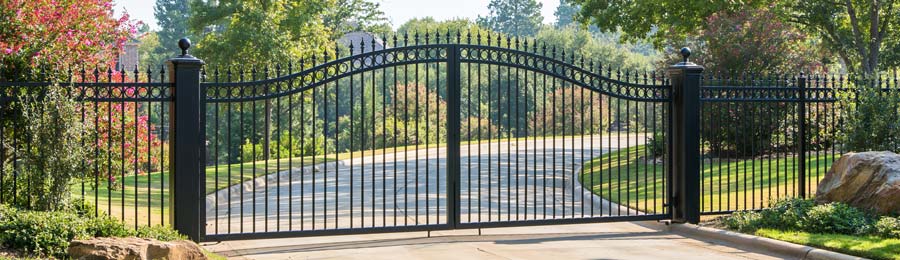
A Gate That Looks Like It Belongs There
A stock gate is a standard panel in a standard size. It works. But in most residential and commercial applications, a gate that matches the fence it connects to — same material, same profile, same post style, same finish — makes the entire installation look like it was designed as a system rather than assembled from separate purchases.
Custom gate fabrication is the right answer in three situations: when replacing a gate in an existing fence and a stock panel won’t match what’s already there, when installing a new fence and gate as a coordinated system from the start, or when the opening is a non-standard size that stock panels simply don’t accommodate.
Materials and Combinations
Custom gates in the Mesquite market are available in all primary fence materials, individually or in combination:
- Wood: Cedar and pine gates built to match privacy or picket fence installations. Fabricated to any height and width within structural limits, finished with the same stain or treatment as the fence.
- Ornamental iron and aluminum: Panels that match the profile, rail spacing, and powder coat finish of an existing ornamental fence. Also available as standalone pedestrian or driveway gates where no fence is part of the project.
- Vinyl: Panels and hardware matched to the existing fence manufacturer and color where possible, or fabricated to coordinate closely where an exact product match isn’t available.
- Combination frames: Steel or aluminum structural frames with wood, vinyl, or decorative infill panels — common for driveway gates where structural mass is a priority and the appearance of a secondary material is the design goal.
Matching to an Existing Fence
Matching a new gate to an existing fence is the most common custom gate request in residential work. The most useful information for accurate matching is the fence material, manufacturer if known, profile dimensions, and finish or color. For older fences where the original source isn’t documented, an on-site visit to assess the fence directly is the most reliable starting point — and that visit is part of every estimate.
Pedestrian Gates, Driveway Gates and the Automation Option
Gate Type, Size and How the Process Works
Pedestrian Gates vs. Driveway Gates
Pedestrian gates are walk-through gates — typically 36 to 48 inches wide, matching the fence height — installed in a fence line for foot traffic access. They’re the most common custom gate request in residential work and are straightforward to match to any fence material.
Driveway gates span the full driveway opening, which runs from roughly 10 to 16 feet for a standard residential single-car or double-car entry. A single-panel driveway gate requires clearance on one side to swing open; a dual-panel gate divides the opening and reduces the individual panel clearance each side requires. For non-standard or wider openings, fabricating to exact measurement is the specific advantage custom work offers over stock panels — the gate fits the opening rather than the opening being modified to fit the gate.
Adding Automation
Any custom gate can be designed from the outset to accommodate an automatic operator. Specifying the automation intent at the design stage allows the gate to be built with the structural reinforcement the operator mounting requires, rather than retrofitting hardware onto a gate that wasn’t designed for it. Automatic driveway gate installation covers operator types, power options, and access control integrations in full.
How the Process Works
A custom gate project follows a clear sequence. The estimate visit covers gate size, material selection, fence match assessment, and — if automation is planned — operator specification. Fabrication timelines vary by material: wood gates are typically ready within one to two weeks of order confirmation; iron and aluminum gates that require welding and powder coating run two to four weeks depending on current production lead times. Installation follows fabrication and is typically a half-day to full-day project depending on gate size and whether new posts are required alongside the gate.
Ornamental iron fence installation and wood fence installation are both available as coordinated projects alongside a custom gate installation for homeowners building a complete fence and gate system.
Every custom gate estimate is free, covers material and size options, and is based on a real look at your property and existing fence before anything is specified or ordered.
Common Questions About Custom Gates in Mesquite
What materials are available for custom gate fabrication?
Custom gates can be fabricated in cedar, pine, ornamental iron, aluminum, vinyl, or combinations of structural and decorative materials. The most common residential choices in the Mesquite area are cedar for wood fence systems, ornamental iron or aluminum for front yard and driveway applications, and vinyl for homeowners who want a maintenance-free gate to match a vinyl fence. Combination gates — a steel or aluminum structural frame with wood or decorative infill panels — are a strong option for driveway gates where the frame needs to handle operator torque loads and the appearance of another material is the design goal.
Can a custom gate be matched to an existing fence?
Yes, and matching is one of the primary reasons homeowners choose custom fabrication over a stock gate. The most important variables for an accurate match are the fence material, manufacturer if known, profile dimensions, and finish or color. For wood fences, matching the lumber species, board width, and spacing is usually straightforward. For ornamental iron, matching the picket profile and rail dimensions allows the gate to read as part of the original installation. For older fences where the source isn’t documented, an on-site assessment is the most reliable way to determine the best available match before fabrication begins.
How long does it take to fabricate and install a custom gate?
Wood gates are typically fabricated and ready for installation within one to two weeks of order confirmation. Iron and aluminum gates that require welding, finishing, and powder coating generally run two to four weeks depending on current production schedules and material availability. Installation itself is typically a half-day to full-day project once the gate is ready, depending on gate size and whether new posts are being set. Lead times can extend during high-demand periods — getting an estimate and confirming the order early in the project timeline avoids delays when a fence project is being coordinated with other work.
Are custom gates more expensive than standard stock gates?
Custom fabrication costs more than a stock panel of comparable material and size — the premium covers the labor involved in matching dimensions, material selection, and any finish work specific to the project. For applications where a stock gate would fit and match adequately, the cost difference may not be justified. For applications where fit, material match, or a non-standard opening size is the priority, custom fabrication is often the only practical option. The estimate conversation covers both paths — stock where it works, custom where it’s the right call — so the decision is based on the actual project rather than a default recommendation.
Can custom gates be automated?
Yes. Custom gates designed from the outset for automation are built with the structural reinforcement operator mounting requires. The gate material and frame weight are specified with the operator’s torque capacity in mind, and the post depth is set accordingly. Adding automation to a custom gate after the fact is sometimes possible but depends on the existing post depth and the gate’s structural condition. Specifying the automation intent at the design stage is the cleaner and more reliable approach in almost every case.
Do custom wood or iron gates require different maintenance than a standard fence gate?
Maintenance requirements follow the material, not whether the gate was custom-fabricated. A custom cedar gate requires the same staining and periodic inspection as cedar fence boards — typically every two to three years in the North Texas climate. A custom iron or aluminum gate requires the same finish inspection and touch-up protocol as ornamental fence panels — annual inspection and prompt attention to any chips or bare metal. The gate hardware — hinges, latches, and any operator components — benefits from occasional lubrication, which is straightforward with standard hardware lubricant applied once or twice a year.